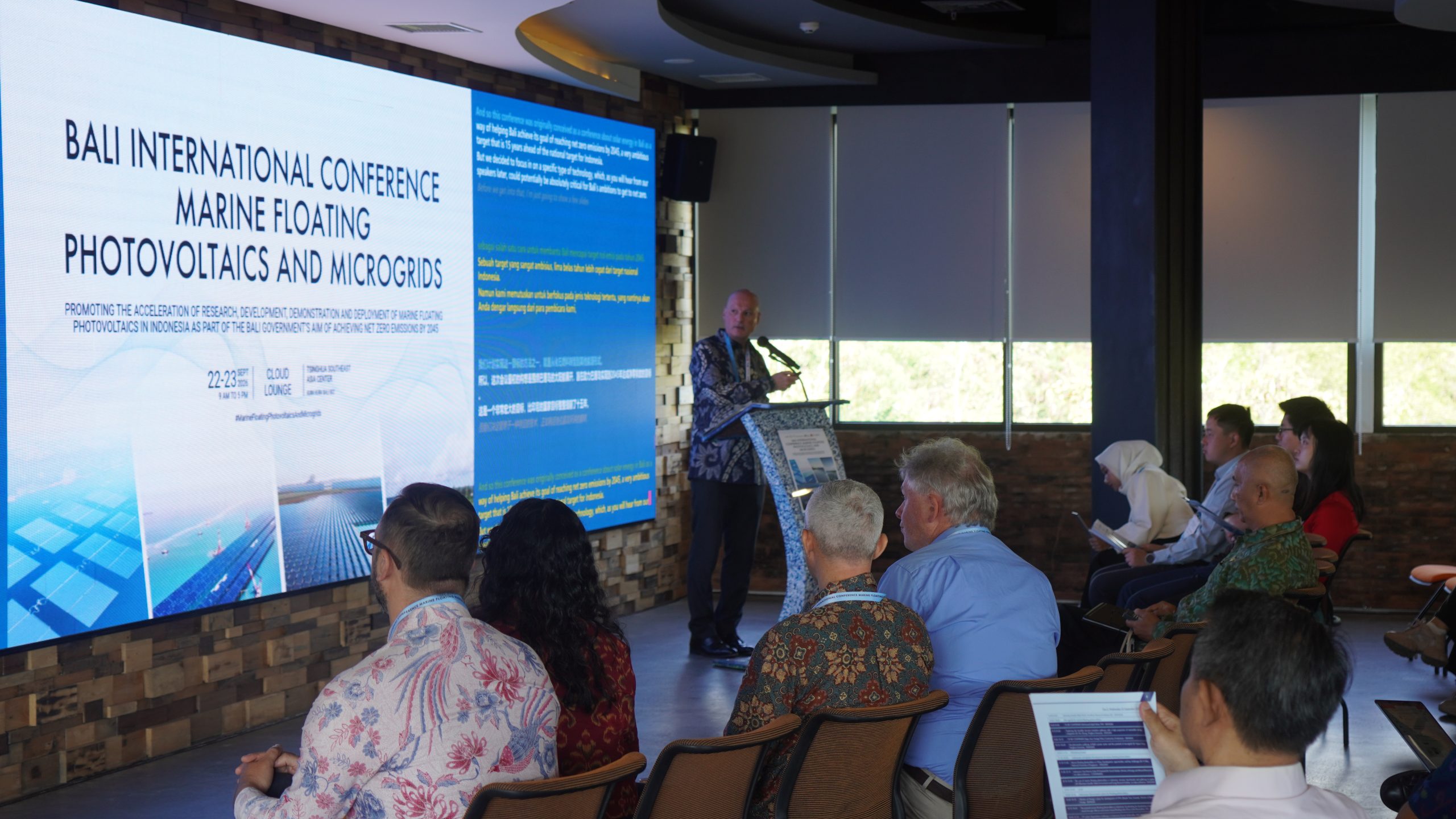
The Bali International Conference on Marine Floating Photovoltaics and Microgrids took place from September 22nd to September 23rd, 2026, hosted at Tsinghua Southeast Asia Center, Bali, Indonesia. Jointly organized by the Grantham Research Institute on Climate Change and the Environment (LSE), the Institute for Climate Change and Sustainable Development (Tsinghua University), the Tsinghua Southeast Asia Center, United in Diversity (UID), and the Institute for Essential Services Reform (IESR). The conference brought together global experts, government decision-makers, energy leaders, and researchers to support the goal of achieving Bali’s net-zero emissions by 2045.
The conference opened on September 22nd commenced with remarks by Bob Ward (Grantham Research Institute, The London School of Economics and Political Science) and Shobi Lawalata (United in Diversity). The first session, focusing on Bali’s climate vulnerabilities and zero-emission goals, featured presentations on Bali’s Roadmap for 2024 Net Zero Emission by Ir. Ida Bagus Setiawan, ST., M.Si. (Energy Department, Bali Province), climate change impacts on local coral reefs by Derta Prabuning (Reef Check Indonesia), and initiatives by the Bali Net Zero Taskforce presented by Prof. Ida Ayu Dwi Giriantari (Udayana University). The discussions transitioned to Bali’s power system, featuring energy transition strategies from Fajar Budi Suryawan (PLN Nusantara Power), the Bali Net-Zero Emissions 2045 power blueprint by Fabby Tumiwa (IESR), and innovations to accelerate sustainability by Andi Tenri Olle (SUN Energy).
The afternoon sessions addressed national and international developments in ocean-based solar systems. Speakers explored collaborative innovations with women seaweed farmers presented by Bradley Parrish (University of Sussex), global development overviews by Dr. Josefine Selj (Institute for Energy Technology, Norway), floating solar photovoltaic development challenges by Prof. Ir. I Ketut Aria Pria Utama (ITS), ocean-based floating solar farms by Dr. Luofeng Huang (Cranfield University), Dutch marine floating photovoltaics developments by Dr. Wiep Folkerts (TNO), and regional applications by Daniel Reinhardt (Swimsol).
On September 23rd, the discussions focused on microgrids and grid integration pathways. Morning sessions highlighted feasible renewable energy transition models presented by Dr. Shu Zhang (Tsinghua University), national energy perspectives by Agus Sari (FPCI), and power sector microgrids by Dr. Yujuan Fang (Tsinghua University). Subsequent global and national technology benchmarks were provided by Dr. Yi Wen (National University of Singapore), Dr. David Silalahi (Ministry of Energy and Mineral Resources), and Dr. Oktoviano Gandhi (Qatar Environment and Energy Research Institute).
The afternoon sessions covered government transition plans and operational viability, featuring presentations on de-dieselization in Indonesia’s 3T outer islands by Firza Zulmi Rhamadhan (PLN) and PV degradation challenges by Suseto Mahardiko (PLN). The final academic track examined environmental and social dimensions, including marine ecological impacts presented by Dr. Steven Benjamins (Scottish Association for Marine Science), electricity cost implications by Anisa Pratiwi (GRI, LSE), local community dynamics around floating PV plants by Dr. David Rudolph (Technical University of Denmark), and spatial utilization planning by Ketut Gede Dharma Putra. The multi-day gathering formally concluded with closing remarks delivered by Bob Ward.