24 December 2025 – Tsinghua SEA, Bali
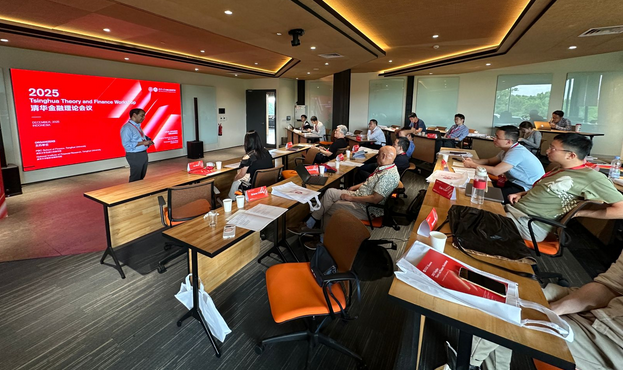
The People’s Bank of China School of Finance 2025 Tsinghua Theory and Finance Workshop was held over two days, 14–15 December 2025, bringing together leading scholars in economics and finance for in-depth academic exchange. Hosted in a professional and collaborative setting, the workshop aimed to foster discussion on current theoretical and empirical issues in finance, with participants from prominent universities and research institutions around the world.
On Day 1, the workshop opened with registration and welcoming remarks, followed by a series of academic sessions focusing on risk preferences, intertemporal decision-making, and learning about discount rates. The morning continued with discussions on socially responsible investing and firm–stakeholder relationships, highlighting contemporary debates in financial economics. After a group photo and lunch, the afternoon featured a keynote speech on dynamic venture capital financing, providing strategic insights into evolving investment behavior. The day concluded with sessions on mergers and acquisitions as well as SPACs, before closing with a networking dinner.

Day 2 commenced with sessions examining financial stability and market design, including discussions on deposit insurance, liquidity injection, and mechanisms to prevent financial runs. These sessions offered valuable perspectives on policy and institutional design in modern financial systems. The morning continued with presentations on corporate AI adoption and the structure of partially liquid claims, reflecting the intersection of technology, corporate behavior, and financial contracts.

In the afternoon of Day 2, participants attended a keynote speech on collateral and secured debt, followed by final sessions addressing monopoly power dynamics and collective contracting for coordination. The workshop concluded with closing remarks, summarizing key insights and reinforcing the importance of continued academic collaboration. Overall, the two-day workshop successfully facilitated rigorous discussion, knowledge sharing, and networking among finance scholars, strengthening ties within the global research community.
